Collaboration of MOWCA Training Institutions: Dr Adalikwu Restates Commitment to Maritime Capacity Development Through Quality Human Capital Production
By Raheem Ibrahim
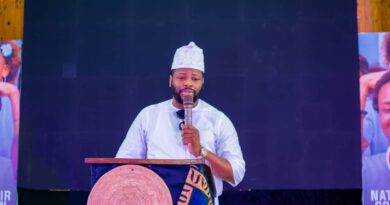
The Secretary-General of the Maritime Organisation of West and Central Africa (MOWCA), Dr. Paul Adalikwu, has restated the organisation’s resolve to bridge maritime human capital gaps through collaboration and synergy among training institutions in West and Central Africa.
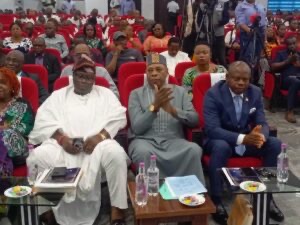
Speaking at the opening session of a four-day exchange visit involving the Regional Maritime University (RMU), Accra, and Académie Régionale des Sciences et Techniques de la Mer, Abidjan, to the Maritime Academy of Nigeria (MAN), Oron, the MOWCA SG noted that over 90% of the region’s trade is carried by sea. However, its capacity to fully harness the benefits of its vast maritime domain depends largely on the quality of human capital it develops.
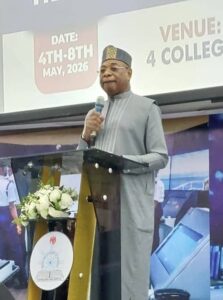
Adalikwu, who expressed optimism that progress can be achieved through synergy, also identified key challenges facing maritime training. These include digital transformation and emerging maritime technologies, decarbonisation and environmental compliance, as well as maritime security concerns in the Gulf of Guinea.
He added that increasing global standards for training and certification can be attained through collaboration, which would, in turn, open up opportunities for the recognition of certificates and enhance maritime job placements for African youths.
According to him, the collaboration will provide a unique platform to harmonise curricula and training standards; promote faculty and student exchanges; share infrastructure, research outputs, and best practices; develop joint certification programmes aligned with international standards; and strengthen regional identity in maritime education and training.
“Ultimately, what we seek to build is not just cooperation, but a cohesive regional maritime knowledge ecosystem. MOWCA remains firmly committed to supporting initiatives that enhance maritime capacity and institutional collaboration across our member states,” he said.
“This aligns with our broader strategic priorities, including the development of a skilled maritime workforce; promotion of safe, secure, and efficient shipping; strengthening regional integration; and providing the needed capacity to support the African Continental Free Trade Area (AfCFTA) and intra-African trade,” he added.
Adalikwu further remarked that the synergy would enhance research into Africa’s contributions toward finding solutions to discussions on alternative fuel energy sources and support the establishment of sustainable maritime institutions, including initiatives such as the proposed Regional Maritime Development Bank.
In his remarks, the Acting Rector of MAN Oron, Dr. Kevin Okonna, described the maiden edition of the exchange visit being hosted in Nigeria as an honour, noting that it aims to establish collaboration among maritime training institutions in the region and globally.
Recalling that in November 2025, MAN Oron hosted officials from RMU Ghana at its graduation ceremony—where a memorandum of understanding was initiated and is nearing full implementation—Okonna revealed that Nigeria’s premier maritime training institution had also visited the Liberian Maritime Administration for a similar partnership aimed at enhancing global recognition of certifications from these institutions.
He commended MOWCA for strengthening efforts to harmonise maritime education and training in West and Central Africa, expressing confidence that the presentations, panel discussions, and interactions would deepen knowledge in areas such as the Standards of Training, Certification and Watchkeeping (STCW), as amended.
Okonna expressed optimism that the synergy would lead to lecturer and student exchanges, socio-cultural interaction, and the promotion of unity within the region’s maritime ecosystem.
Also speaking, the Acting Vice-Chancellor of RMU, Dr. Jethro Brooks, lauded MOWCA’s initiative and called on training institutions across the region to embrace the renewed drive for rapid development of the African continent. He noted that Africa’s challenges are better addressed through collaboration than isolation, with shared resources, aligned curricula, and harmonised systems.
He stated that RMU is uniquely positioned to advance the objectives of the meeting toward producing highly skilled and globally competitive human capital for maritime education and training in Africa and beyond.
Similarly, Colonel Coulibally Kareem, Director-General of the Abidjan-based Regional Academy of Marine Sciences and Technology, appreciated the MOWCA SG for laying the foundation for a sustainable partnership aimed at strengthening African maritime training for global relevance.
Coulibally said the initiative provides an opportunity to compare training curricula and address challenges facing maritime education in the region, while reaffirming the academy’s full support.
A former Head of the African Section, Subdivision for Maritime Development at the International Maritime Organization (IMO), Mr. William Azuh, described the meeting as timely and a bold step toward advancing maritime training development for MOWCA member states and beyond.