
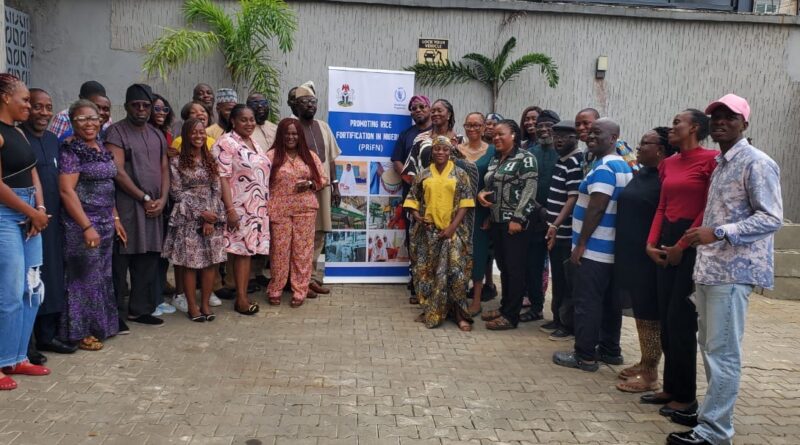
Fortified Rice Drive Gains Momentum as FG Tackles Micronutrient Deficiency
The Project Manager of Promoting Rice Fortification in Nigeria, Mr. Seun Elere, has said the Federal Government’s efforts to reduce micronutrient deficiency among Nigerians are yielding positive results.
Elere also reaffirmed his commitment to ensuring that the consumption of fortified rice spreads across the country as a major step towards addressing micronutrient deficiency.
He spoke during a one day training for journalists on rice fortification held in Ikeja, Lagos.

He explained that the Federal Government’s decision to focus on rice consumption as a vehicle for tackling micronutrient deficiency was informed by the high rate of rice consumption among Nigerian households.
According to him, a report by the National Food Consumption and Micronutrient Survey revealed that micronutrient deficiency is prevalent among children and pregnant women. He added that four of the recommended nutrients are mandatory, while three are optional.
The Project Manager urged Nigerians to embrace fortified rice, attributing the country’s high rice importation to the level of consumption, while noting that local production remains relatively low.
He maintained that rice imported from countries such as China, India and Indonesia is generally not fortified, stressing that locally produced fortified rice offers better nutritional value.

Also speaking, Mr. Robert Irimat of the World Food Programme said malnutrition was not peculiar to Nigeria, noting that the recommended micronutrients were essential in correcting nutritional deficiencies.
According to him, a large number of children affected by malnutrition experience stunted growth and may be unable to perform at the same level as their peers.
He disclosed that anaemia is one of the major consequences of micronutrient deficiency, while cautioning Nigerians against overfeeding.
Irimat said the consumption of fortified rice was one of the most cost effective ways of addressing micronutrient deficiency, considering the high rate of rice consumption among Nigerian households.
He explained that the idea behind rice fortification was to restore essential micronutrients lost during the production process.
Speaking on behalf of the Standards Organisation of Nigeria, Mrs. Obianwu Nene disclosed that a Code of Practice had been developed from the outset by major stakeholders in rice fortification to ensure that consumers derive the intended benefits from fortified rice.
She said the Federal Government had been deliberate in maintaining the required standards, adding that other African countries were now looking to Nigeria for guidance.
Nene further noted that locally produced rice remained the best option, stressing that some rice sold in the market as foreign products are actually locally produced rice that has been rebagged for higher profits.
Mrs. Fadairo Taiwo of the Lagos State Ministry of Health, meanwhile, cautioned that when rice is clean, repeated boiling during cooking could result in the loss of some vital nutrients.
She urged Nigerians to cultivate the habit of cooking properly and learn to use salt moderately in their meals.
Fadairo, who shared her experience of the fight against goitre during an outbreak in Badagry years ago, stressed the need for intensive grassroots campaigns on fortified rice if the government is to achieve its desired results.