Lagos Farmers Hail Introduction of Soilless Farming, Seek Wider Access to Training
Farmers across various agricultural sectors in Lagos State have welcomed the decision of the state government to introduce the soilless farming system, otherwise known as hydroponics.
They, however, urged the government to ensure the periodic and decentralized implementation of the training programme to enable more farmers to benefit from it and boost food production across the state.
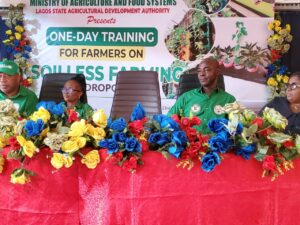
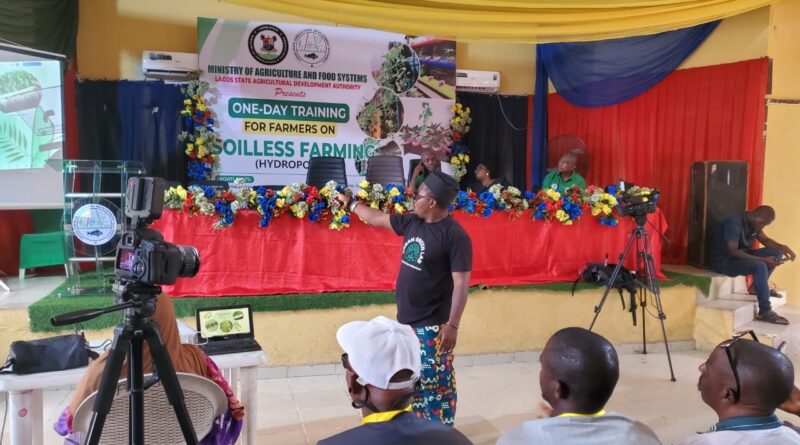
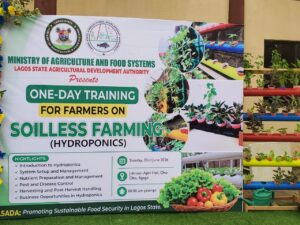
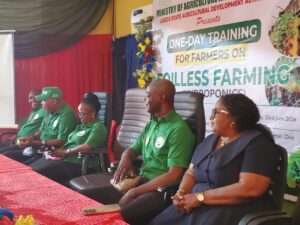
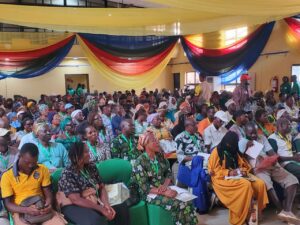
The farmers made the appeal during a one-day training on soilless farming organised by the Lagos State Ministry of Agriculture and Food Systems in collaboration with the Lagos State Agricultural Development Authority (LSADA). The training was held at the Johnson Agri Hall, Oko-Oba, Agege.
Speaking at the event, the facilitator, Mr. Faruk Onaolapo, said the era when farming was regarded as a retirement plan or when farmers were considered irrelevant in society had passed. He noted that more Nigerians are embracing agriculture due to its significant economic benefits.
Onaolapo, who is the Managing Director of Soilless Farm, stressed that farmers must understand the type of soil suitable for different crops and know when to apply insecticides, nutrients, and fertilizers to achieve better yields and maximize returns on their investments.
According to him, climate change has become a major challenge for farmers, making it necessary to adopt technology and innovative farming methods.
Explaining the concept of soilless farming, the facilitator described it as a simplified and efficient farming system that replaces key soil nutrients with alternatives such as rice husk and cocoa peat to support crop growth.
He also encouraged participants to conduct further research on soilless farming to deepen their knowledge and apply the technique on their farms.
In her welcome address, the Head of Crops Development Sub-Component at the Lagos State Agricultural Development Authority, Dr. Buk Sadiku, commended farmers for remaining committed to food production despite numerous challenges and constraints.
She noted that the importance of farmers to national development cannot be overstated, wondering what would happen if farmers decided to embark on a strike. According to her, their contributions remain invaluable despite the challenges posed by unpredictable weather conditions.
Dr. Sadiku stated that Lagos has the smallest land mass among Nigerian states but one of the highest population densities, a situation that informed the government’s decision to embrace technology-driven farming systems such as hydroponics to meet the food needs of residents.
She further explained that the introduction of soilless farming is aimed at scaling up food production through a smarter, more resilient method of cultivation that does not rely on soil.
According to her, the system is also designed to encourage households to embrace subsistence farming as a pathway to sustainable food security amid the state’s rapidly growing population.