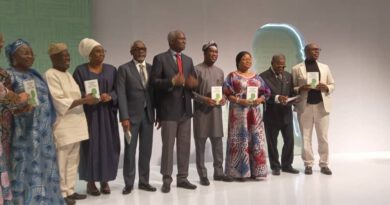
‘Nigerian Governors Are Making Their States Suffer’ – Leadership Expert Laments Lack of Continuity and Sustainability in State Governments
Nigerian Entrepreneur and Philanthropist Dr Adebola Ismail Akindele says many Nigerian states are suffering economically due to “the lack of continuity and sustainability”, as he laments the norm of state governors abandoning the projects and programmes of their predecessors.
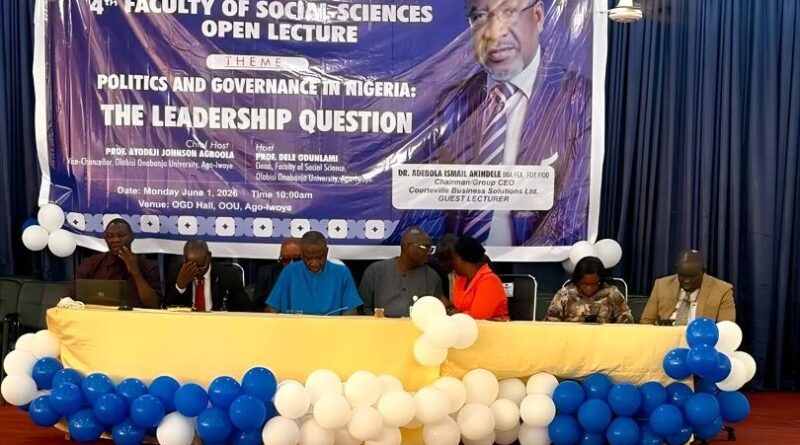
Dr Akindele said this while delivering the 4th Open Lecture of the Faculty of Social Sciences, Olabisi Onabanjo University, Ago-Iwoye, Ogun State, titled “Politics and Governance in Nigeria: The Leadership Question” on Monday.
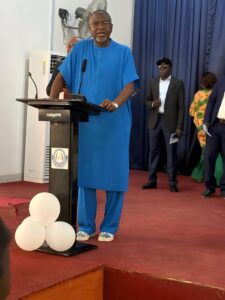
•Guest lecturer, Dr. Akindele
Dr Akindele, while speaking on political leadership in Nigeria, attributed Lagos State’s economic progress to successive administrations implementing the same governance template since 1999 and said other states were lagging due to constant changes in government priorities.
He also remarked that “most politicians don’t deliver because they got into office through vested interests, who usually don’t have the best interests of the people at heart.”
Dr Akindele, the Group Chief Executive Officer of Courteville Business Solutions Ltd., called for the formulation and implementation of homegrown solutions to the country’s economic and political challenges, rather than relying on foreign concepts and ideas, and noted that policies, ideas, and solutions that are world-standard and proven to deliver in other countries don’t work in Nigeria, as Nigerians “are a different people.”
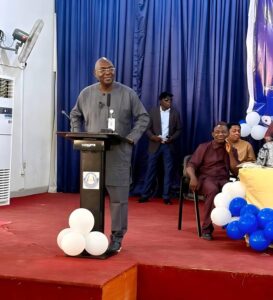
•Vice-Chancellor of the university, Professor Agboola
He, however, stated that the same is the case in other developing countries and said that “we can’t separate the politics of Nigeria from the rest of Africa and the rest of the developing world, especially Latin America.”
Dr Akindele also observed that the handful of Third World countries that have recorded economic transformation, including China, Singapore, and Rwanda, did so under “strongmen dictators”, but noted that such would not be practicable in the country, saying that “Nigerians are against dictatorships.”
Akindele, while emphasising the importance of leadership at all levels, defined leadership as “getting people united behind oneself to deliver a goal, without force or coercion.”
He added that “empirical studies have shown that since the beginning of mankind, three things decide where people gravitate to, for leadership: Similarity, Comfortability, and Familiarity”, explaining that followers must be similar in beliefs and identity, and comfortable with the person of a leader, before adhering to their leadership.
He explained that the idea of leadership is in four parts: Initiate, Decide, Execute, and Activate. He said that “there are four things leadership requires at all levels. Leaders initiate projects, programs, and policies. Then they decide on the course of action to take, execute the actions, and activate their team.”
Dr Akindele also stressed the need for leaders to be clear when communicating their ideas. He said that “one key variable for leadership to succeed is for the objective to be unambiguous and to be clear. The efforts and actions of leadership should be clear.”
In his opening remarks, the Dean of the Faculty of Social Sciences at the Olabisi Onabanjo University, Professor Dele Odunlami, said the open lecture is “a flagship town-and-gown event for the deliberation of contemporary issues. This event becomes important as we approach the 2027 elections, especially on the issue of whether Nigeria needs good leadership or good followership.”
The Vice-Chancellor of the university, Professor Ayodeji Agboola, who presided over the lecture and declared it open, said that “leadership, politics, and governance are critical issues worth exploring, as the quality of leadership and followership is indicative of a society.”
The 2026 Open Lecture of the Olabisi Onabanjo University’s Faculty of Social Sciences is the fourth edition in the series. The first lecture in 2014 was delivered by Dr Adewale John Abolurin, the then Director General of the Nigeria Security and Civil Defence Corps (NSCDC), followed by Harold Demuren, a former Director General of the Nigerian Civil Aviation Authority (NCAA) in 2018, and Dr Tunji Olugbodi, an advertising and marketing guru in 2023.